Picky eaters
Your dog isn’t picky. Dinner just stopped smelling like food.
A dog settles the question with its nose, before the bowl reaches the floor. That part is fixable in three minutes.
You put the bowl down. Your dog gets up, walks over, lowers its head for about a second and a half, and then goes back to the couch without eating a thing. The food is good food. You paid for good food. It sits there until you throw it out.
The reflex at that point is to buy a different bag. Most people go through three or four of them. It is an expensive way to test a theory, and it usually fails for a reason that has nothing to do with the recipe: your dog never got far enough into the meal to have an opinion about it. The decision was made at the sniff.
That is worth taking seriously, because it points at a much smaller problem than the one you think you have. You may not need to replace the food. You may only need to give it back a smell.
First, the part nobody wants to read
A dog that stops eating is sometimes telling you something medical, and no topper fixes that. The Honest Kitchen’s own guidance on this is blunt: if you notice any change in your dog’s appetite at all, contact your veterinarian. Work down this list before you decide you have a picky dog.
Rule these out first
- IllnessGastrointestinal upset, parasites, kidney or liver problems, cancer, respiratory illness, and endocrine disorders such as Addison’s, hyperthyroidism or hypothyroidism can all suppress appetite.
- TeethTooth decay and gum disease make chewing painful, and dry kibble is the hardest thing in the house to chew. Dental problems are extremely common in dogs.
- Recent surgery or medicationA queasy stomach after a procedure usually resolves as recovery progresses.
- Stress and changeA move, a new dog, a loss in the family, even rearranged furniture. One study published in Scientific Reports found that 72.5 % of dogs demonstrated at least one anxiety-related behavior.
- Learned habitsIf your dog will refuse dinner and then happily accept treats or table scraps, the behavior is trained, not medical. Scale the extras back and expect a few days to a week.
- Where the bowl sitsA bowl placed next to another dog’s can make a dog uncomfortable enough to leave it. Moving it is free.
If your vet clears your dog and the bowl still comes back full, you are in the last category, and that category has a mechanism.
A dog reads a bowl the way you read a page
Walk into a room and the first thing you do is look around. Your dog does the same job with its nose, and does it far better than you do. Estimates put a dog’s sense of smell somewhere between 10,000 and 100,000 times more sensitive than ours, depending on whom you ask.
James Walker, former director of the Sensory Research Institute at Florida State University, put the low end of that range into a picture that is hard to forget. Assume dogs are only ten thousand times better, he said, and then make the analogy to vision: what you and I can see at a third of a mile, a dog could see more than three thousand miles away and still see it just as well.
The anatomy behind it is unusual, and it is the reason a dog can size up a bowl in a single breath.
Why one breath is enough
- Toward the olfactory chamber. The smelling path.
- Toward the lungs. The breathing path.
- Exhaled sideways through the slits at the sides of the nose, which stirs fresh scent back toward it.
So when your dog spends a second and a half at the bowl, it is not being lazy or fussy. It is running the only test it trusts, and it is running it at full resolution. The bowl either smells like food or it does not.
What happened to the smell
Here is the uncomfortable part, and The Honest Kitchen says it about the category it competes in rather than about itself.
Most conventional dry food is built for convenience and shelf stability first. It is cooked at high heat and stripped of moisture, which is exactly what makes a bag last a year in a cupboard. Those two steps also take out most of what a nose was going to find. So to get a dog interested in the result, manufacturers spray flavor coatings, called palatants, onto the outside after the fact.
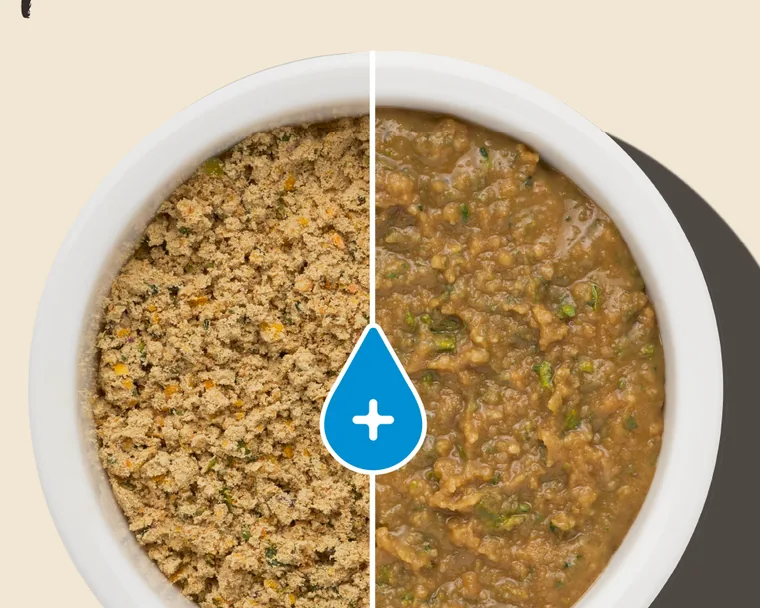
Two ways a bowl can smell
A dog is not fooled by that arrangement so much as bored by it. A sprayed coating is a thin, flat signal, identical from the first day of the bag to the last. There is nothing in it to investigate.
The reframe
A bowl of dry food is not an offer. It is a photograph of an offer. Warmth, moisture and aroma are the three things drying takes out, and they are the three things a dog checks for. Put any of them back and the bowl becomes a different proposition, using the same base food you already bought.
The fix is smaller than a new bag
The Honest Kitchen’s own advice for the dog who sniffs and walks away is not to change the food. It is to start with something aromatic and moisture-rich, and to serve it warm, which lifts smell, temperature and texture at the same time. For a dog that eats with its nose, they note, that is often all it takes.
Broth and real meat give the nose something to work on. This is the lever that decides whether the dog stays.
Warm food releases more aroma than cold food. Warm water is the cheapest part of the whole fix.
Moisture coats the kibble and carries flavor into it, instead of leaving it dry and dusty.
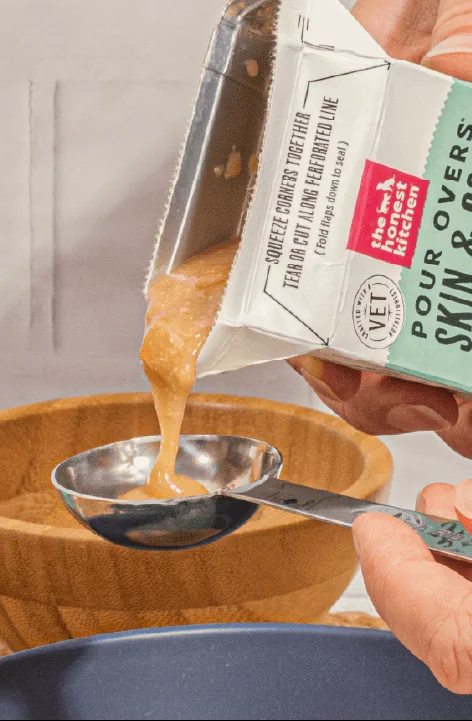
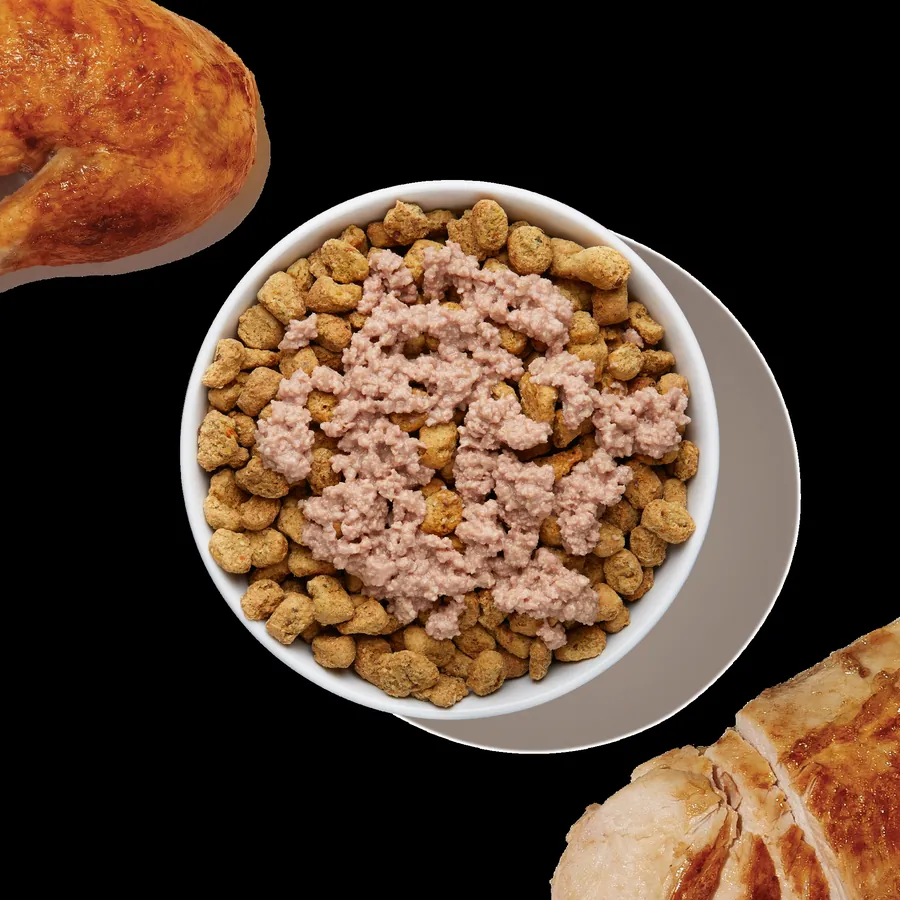
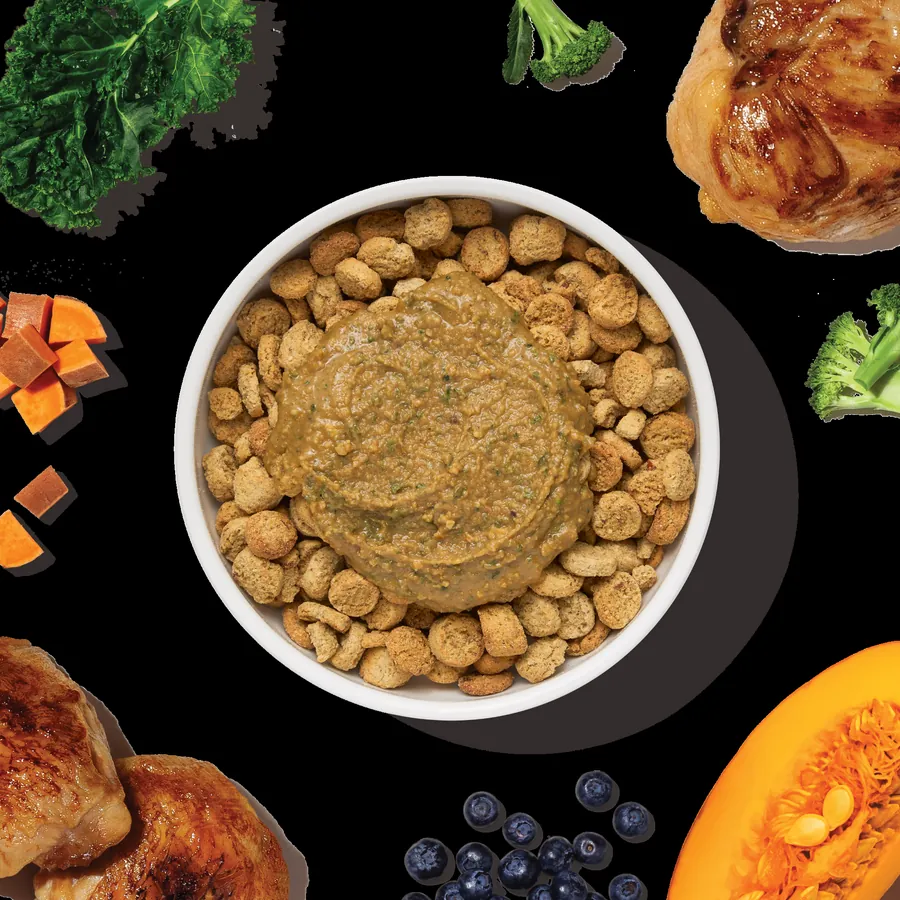
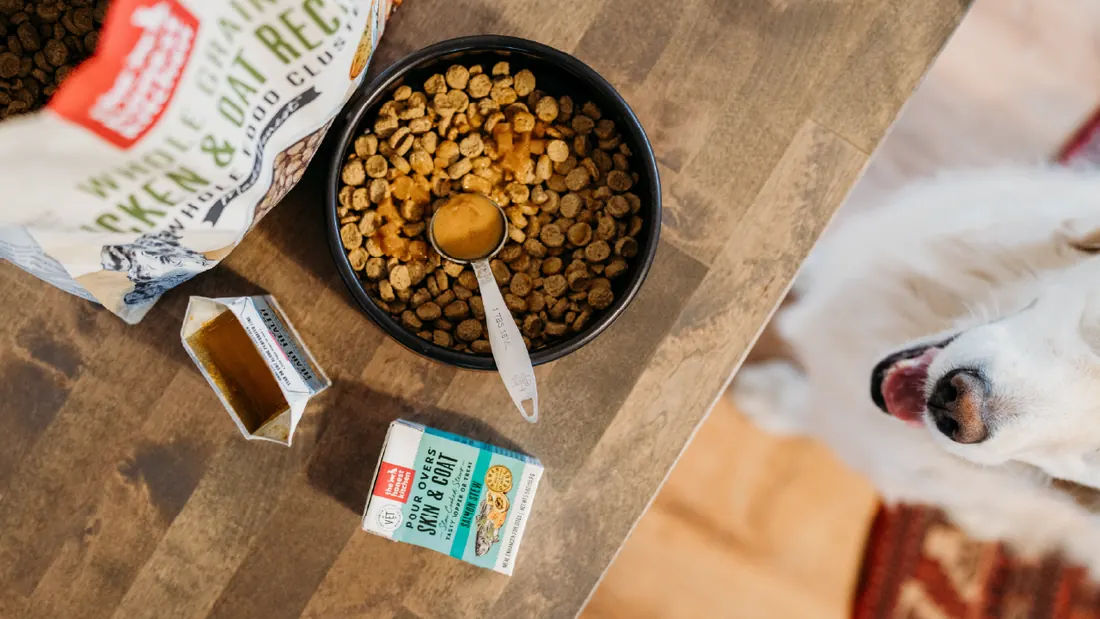
In practice that is one box or one scoop, poured over what is already in the bowl, stirred through. Nothing about the base meal changes. The reason it can work the same evening is that you are not waiting on digestion or on some slow adaptation. You are changing the thing the dog samples first.
The tell is the box, not the bowl
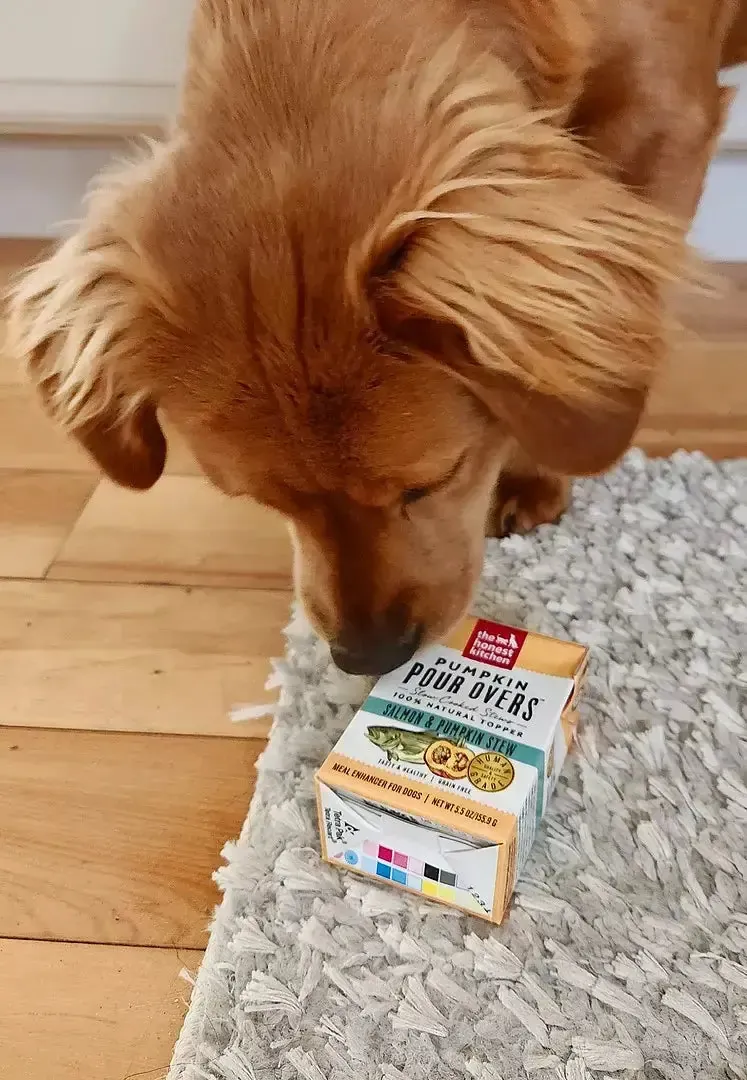
Read enough owner reviews of these toppers and one detail keeps surfacing that nobody seems to have set out to report. The dogs do not start reacting when the food is served. They start reacting when the box comes out of the cupboard.
My older dog used to just look at her bowl and walk away. Uninspired by the dry kibbles awaiting her. With the pour overs she sits ready to eat the moment I pick up the bowls!
Susan S., verified buyer, on Pumpkin Pour Overs, Chicken
My young labradoodle, Remy, decided to be a picky eater early on, so we started trying different additives. Not only does she start dancing around when we get out the chicken meal-booster, she eats it all super-fast and has no digestive issues.
Charles K., verified buyer, on Meal Booster, 99 % Chicken
It’s always fresh and smells good and pumpkin-y. The Pugs know exactly what it is and get pretty excited when they see the little box.
Peggi L., verified buyer, on Pumpkin Pour Overs, Chicken
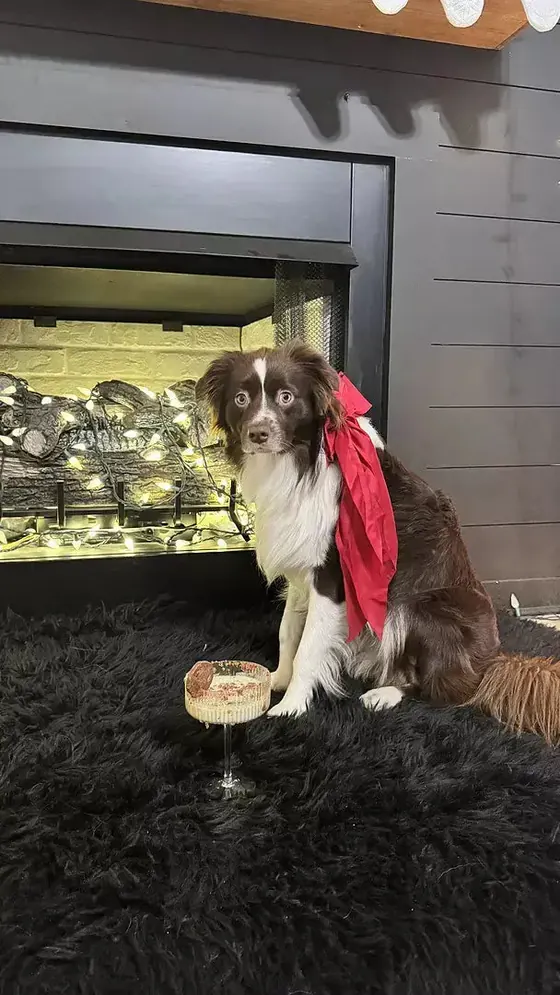
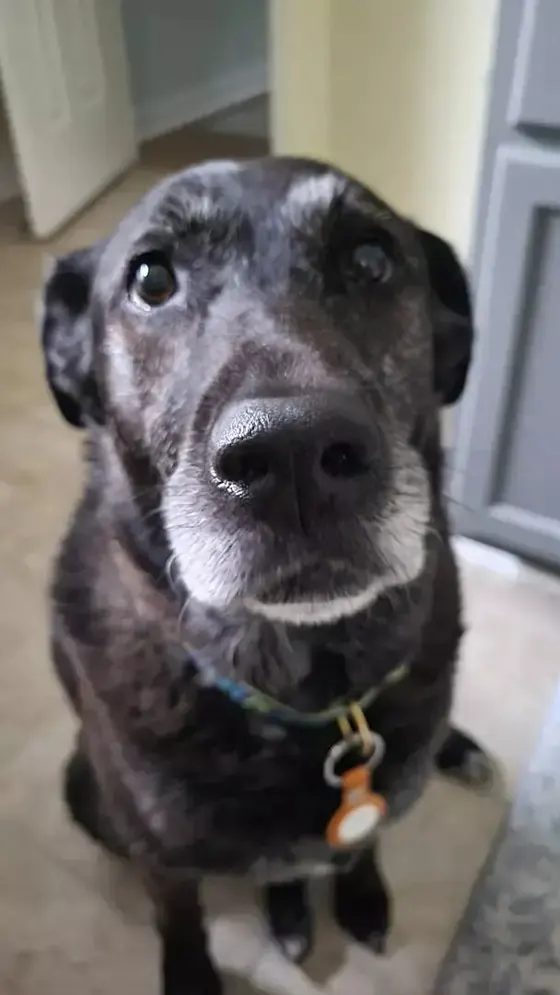
That detail matters more than the enthusiasm does. A dog that gets excited at the sight of a closed box has smelled it through the cardboard, which is precisely the argument this article has been making. And it tells you which lever moved: not nutrition, not recipe, signal.
I have a picky eater here. At first he gobbled up his dehydrated chicken, then nibbled at it, then turned up his nose to it and anything else offered. So I decided to offer kibble and it was good for a minute and he began the same behaviors. Then I bought the pour over broth and he once again is a gobbler of his food. Ronnie W., verified buyer, on Bone Broth Pour Overs, Chicken
Ronnie’s account is the whole pattern in one paragraph: a dog cycling through foods, each one working for a few days and then failing, until something changed at the top of the bowl rather than underneath it.
Always hit and miss as to whether our pooch will dive into her meal. The chicken meal booster changed that! It only takes one third of a box lightly mix to have her clean the bowl
John R., verified buyer, on Meal Booster, 99 % Chicken
My 16 year old dog doesn’t have the gusto for eating that he had in his youth. These pour overs have been a lifesaver. While we still have to sometimes spoon-feed him, he does manage to finish off each meal. Licking the topping off his food seems to stimulate his appetite.
Rosemary M., verified buyer, on Superfood Pour Overs, Chicken
And the honest version
It does not turn every dog into a hoover. One owner of an extremely picky dog reports that the chicken topper gets her going, but that she only wants it every third day. Her verdict was still that it works, which is a fair way to hold it: a topper changes the odds at a given meal, it does not rewrite a dog’s temperament.
How much, and the one mistake to avoid
A topper is an addition, not a meal. It is not complete and balanced on its own, and the base food underneath it still has to be doing the work. The failure mode here is easy to miss because it is slow: you add a generous pour twice a day, you do not adjust anything else, and the dog quietly gains weight over a few months.
The rule of thumb The Honest Kitchen publishes is the one most veterinarians use. Keep toppers to roughly 5 to 10 % of daily calories, and if you are adding calories on top, take a little off the base meal to compensate.
A worked example
A dog eating 400 calories a day has a conservative topper budget of about 20 to 40 calories. That is plenty for a generous pour of bone broth or a small protein topper at each meal.
On volume rather than calories, their published serving guide for the pour over format runs by body weight.
| Dog | Daily amount | Scaling rule |
|---|---|---|
| Up to 10 lbs | 1 tbsp | Add 1 tbsp per 5 lbs of body weight, up to 40 lbs |
| 40 lbs | 4 tbsp | Add 1 tbsp per 10 lbs of body weight, up to 70 lbs |
| 70 lbs | 1 box | Add 2 tbsp per 10 lbs of body weight over 70 lbs |
Serving guidance as published by The Honest Kitchen for Functional Pour Overs. Suitable for puppies, adults and seniors, all breeds and sizes.
Which one, honestly
There are six formats and they are not interchangeable. If the problem is a dog that will not start eating, the deciding factor is aroma and moisture, which points at the wet pour overs rather than the dry ones. If the problem is a thin dog or a dog on a limited diet, protein density matters more.
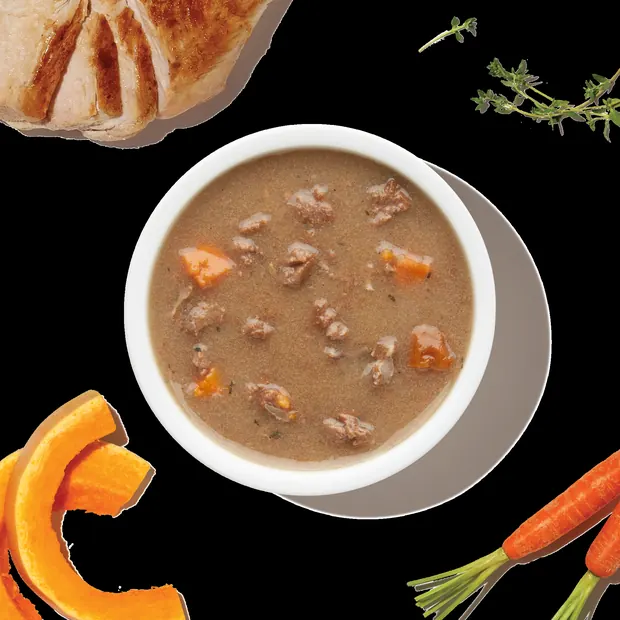
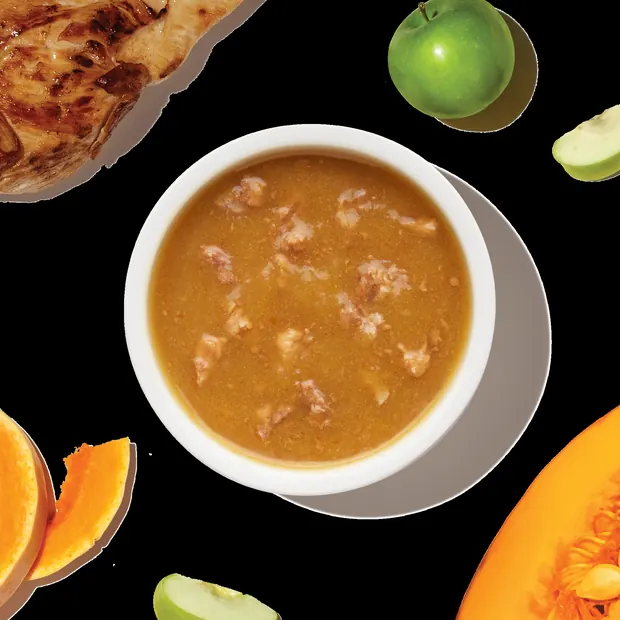
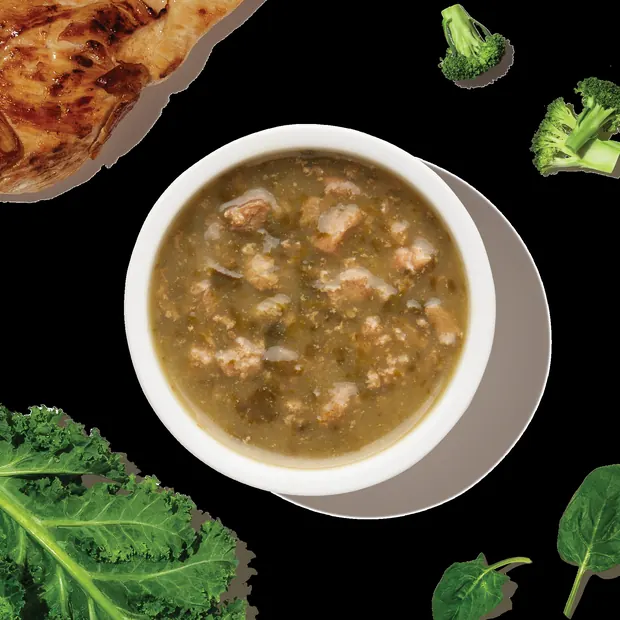
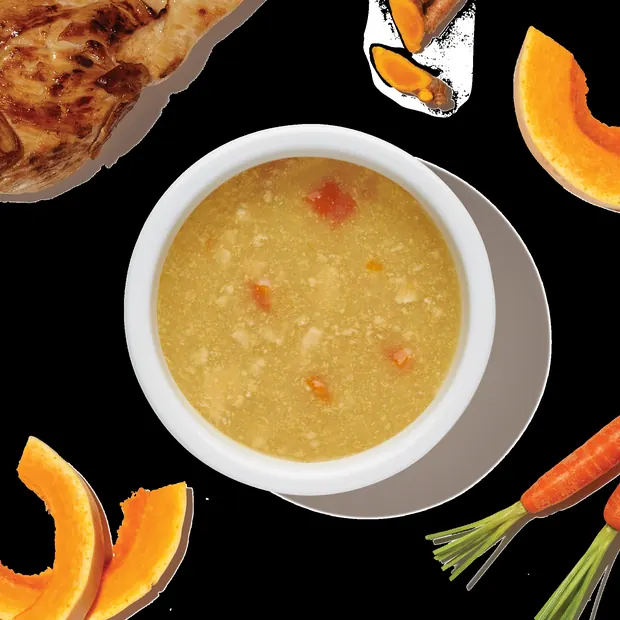
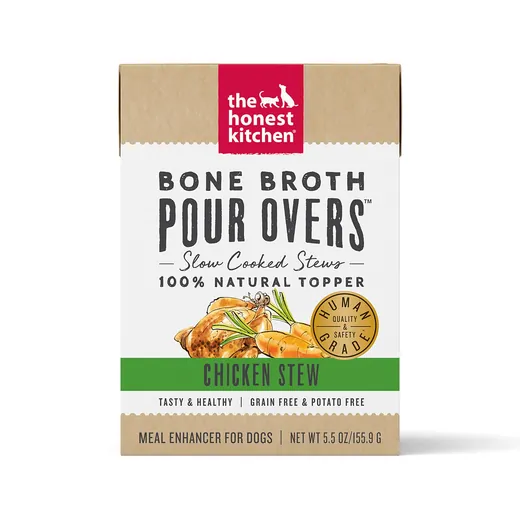
$31.0812 boxesBone Broth Pour Overs
The default for a dog that will not start eating. Gut and joint support.
Chicken bone broth, chicken, carrots, butternut squash, tapioca, thyme, sage.
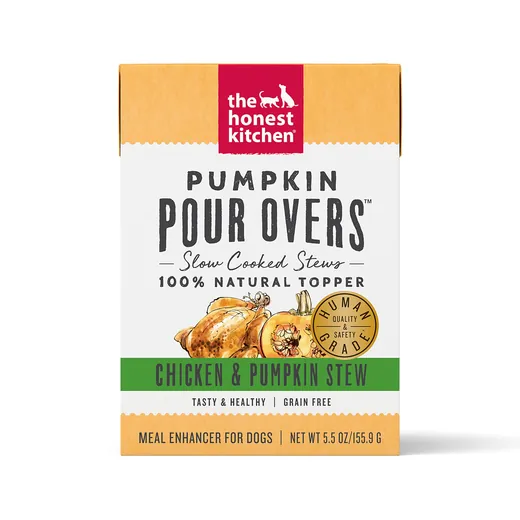
$31.0812 boxesPumpkin Pour Overs
The same aroma advantage, aimed at digestion.
Fiber-rich pumpkin, pureed apples, cinnamon.
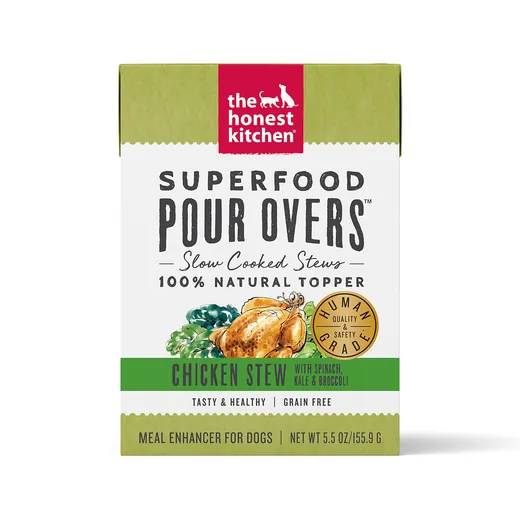
$31.0812 boxesSuperfood Pour Overs
For owners who want the greens in without a fight.
Chicken bone broth, cage-free chicken, spinach, kale, broccoli.
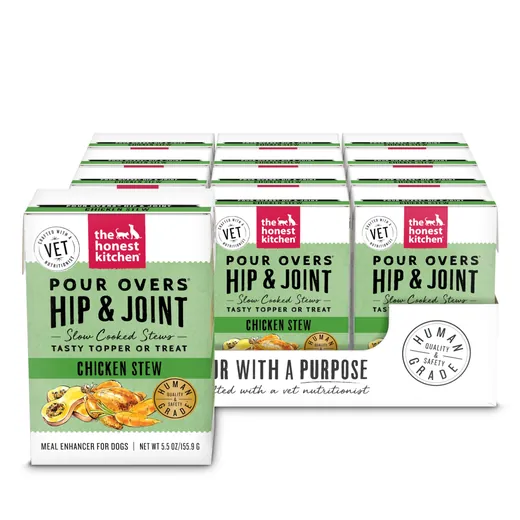
$39.4812 boxesFunctional Pour Overs
A named health target on top of the aroma. Crafted with a veterinary nutritionist.
Four recipes: skin and coat, hip and joint, immune support, heart health.
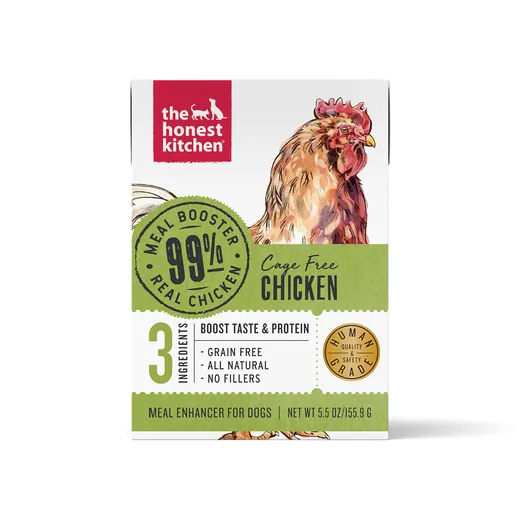
$41.8812 boxesMeal Booster, 99 % meat
Maximum protein density, minimum ingredients. Good for limited diets.
Cage-free chicken, water, agar-agar. That is the whole list.
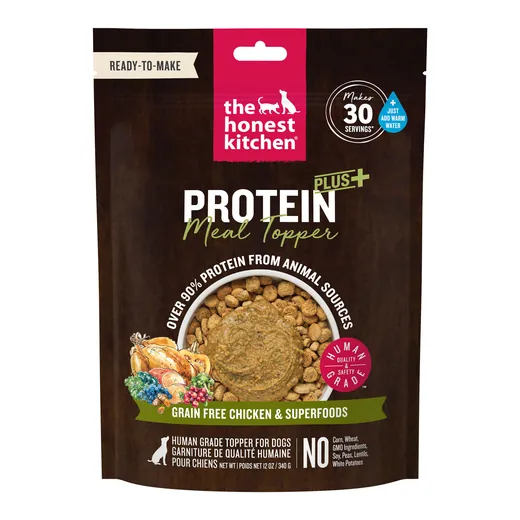
$14.9930 servingsProtein Plus
The shelf-stable one. You control the water, so you control how wet and how warm.
9 ingredients, over 90 % protein from animal sources, 44 g protein per serving.
The dehydrated option deserves a note, because it is the one that gives you the temperature lever directly. You mix it with warm water, stir, and wait three minutes. Less water makes a chunky pate, more water makes a gravy. If your dog responds to wet food but you would rather not keep twelve boxes in a cupboard, that is the format to try.
See the full topper rangeOpens thehonestkitchen.com
Who makes it, and why that is the relevant question here
Every argument on this page rests on one thing being true: that the smell in the bowl comes from the ingredients rather than from a coating. That claim is only worth as much as the standard behind it.
The Honest Kitchen was started in 2002 by Lucy Postins, in her kitchen in San Diego, after she could not find a whole food option for a Rhodesian Ridgeback with chronic ear infections and skin problems. Home cooking turned out to be messy and slow, so she moved to gently dehydrating whole foods instead, which kept the nutrients and made the routine manageable. That is still the method.
- 2002Founded. The world’s first human grade pet food, at a time when the standard did not exist in the industry and had regulatory hurdles to clear.
- 2018Pour Overs launch alongside the crunchy treats.
- 2019First human grade dry food for pets, the Whole Food Clusters.
- 2022One of the first US pet manufacturers to become a certified B Corporation.
Human grade is not a marketing word here, it is the reason the sentence above holds. It means the ingredients and the facility meet the same bar as food made for people. Every topper, broth and pour over is made in a certified human food facility meeting more than 100 FDA and USDA safety standards, in the USA.
What is not in it
No gums or carrageenan. No GMO ingredients. No meat meals. No corn, wheat or soy. No artificial preservatives, colors or flavors.
What to do at the next meal
If your vet has cleared your dog and the bowl still comes back full, the experiment is cheap and it runs tonight.
- Pick for aroma, not for nutrition. A wet, meaty pour over gives the nose the most to work with. Save the optimising for later.
- Serve it warm. Warm carries smell. If you are using the dehydrated topper, that is what the warm water is for.
- Stir it through, do not perch it on top. The point is to get moisture and smell onto the kibble itself.
- Stay inside 5 to 10 % of daily calories, and take a little off the base meal if you are adding a lot.
- Give it a week and watch the cupboard, not the bowl. The moment a dog starts reacting to the box, you have your answer.
If it works, you have solved a picky eater for a few dollars a week without replacing anything. If it does not, you have learned something real: the problem was never the smell, and that is worth a second conversation with your vet.
Shop toppersHuman grade, made in the USA. Free shipping on orders over $49 in the US.